
My teenage years were spent largely on the internet. Yeah, I had hobbies, I did stuff, but at night something drew me to the glow of a screen. To teenagers, the internet seems like taste of freedom. For many, it is a place to do the messy work of crafting an identity while affording a little bit of anonymity to its users. The internet contains opportunities to form close bonds and just as many opportunities to break those bonds and ghost out of the picture. An entire ecosystem of communities and social circles exists in a jeans pocket, a family computer, a school laptop. Perhaps the web is its own kind of ghost, an intangible force that has haunted the minds of adolescents for generations now.
Teenager, internet. Moth, flame. This adolescent search for identity and connection is the lens through which Jane Schoenbrun (they/she) presents their film, We’re All Going to The World’s Fair, which premiered at Sundance in 2021. The film follows 15-year old Casey (played by Anna Cobb) as she plunges into an online alternate reality game (ARG) called World’s Fair. This viral challenge, seemingly perpetuated by YouTube content creators, promises real-life, physiological changes to those brave enough to take it. The movie opens with our protagonist joining the challenge, and we soon learn that she has no idea what changes she’s in for. The changes seem either random or perfectly tailored to each player. These range from the seemingly good (a woman proudly showing off her new wings) to the downright weird (the ticket machine. yikes.). Casey initiates herself into the game, and then all she can do is wait to see if the game is real enough to touch her IRL.
Honestly, what’s more typical of a chronically-online teen than buying into something just ambiguous enough to trick you into thinking – or hoping – it could be real? Okay! I admit it! I thought I was doing something groundbreaking back in 2006 when I stumbled upon the DHARMA Initiative ARG that accompanied the TV show LOST. There weren’t hours-long YouTube deep dives or constantly-updated fan wikis at this point, just a rabbit hole of a site created by people who knew exactly what type of fannish folk they were selling to (Me. I was the type). The way I lost sleep over easter eggs and hidden codes in the various LOST web games, you would have thought I was trying to solve Cicada 3301. After a while the creepypastas, ARGs, and URL puzzles left me feeling like a gullible dreamer scouring the vast web for something that felt more real than what I already had. What was true of adolescent me is just as true now as ever: I want to believe in the magic. Someone made an elaborate fantasy playground for me and I want to frolic in it, damnit!
The ARG format is by no means new, but in the age of vertical video, ARG games are more prevalent than ever as a means to tell episodic horror stories. You scroll through “horrortok” and you’re bound to find at least one multi-video account of someone’s haunted house or someone getting stuck in the backrooms. Some of these series play comfortably in the unspoken covenant of creepypasta ambiguity, while some proudly acknowledge the fiction of it all. We all accept these for what they are – content – but there is always that twinge in the back of the mind that reminds us: The world could be full of magic and this could be real. Who can blame us? Real-life horrors are already so weird. Why can’t this twisted, fantastical mystery be true, just this once, just for me?
That sense of yearning for something transformative is exactly the mood that pervades World’s Fair. For all the networking and creating and consuming that occurs throughout the film, Schoenbrun emphasizes just how isolating the online lifestyle can be. We don’t see Casey interact with other people in the so-called “meatspace”. Even as she’s participating in the game, we never really see a sense of belonging. Holed up in her room, safe from her tumultuous relationship with her father, Casey seems to fill every waking moment with the game. She is constantly observing, comparing, contextualizing herself within the whole, and even as the story progresses she never seems any closer to finding what that context actually is.
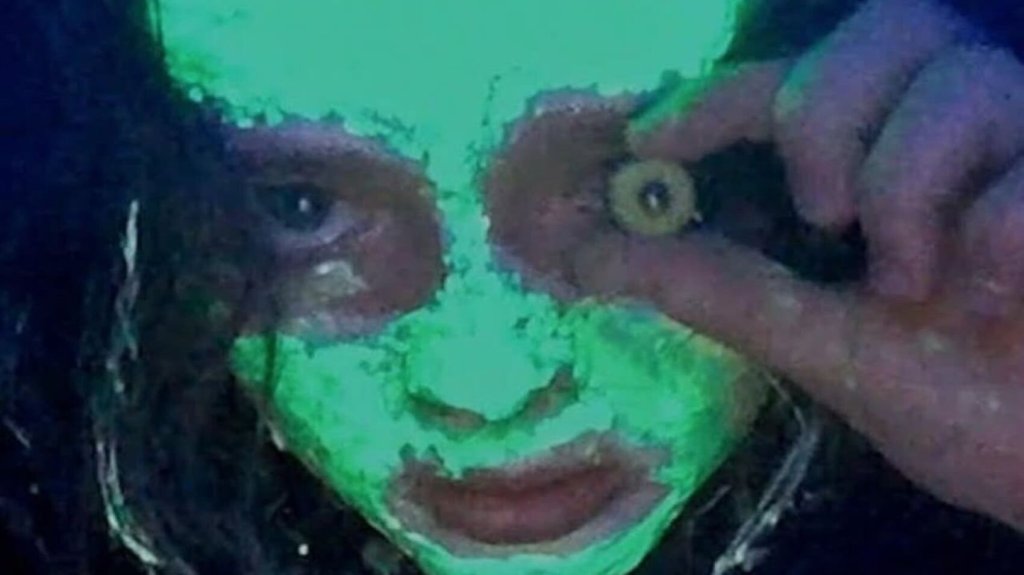
Schoenbrun has stated in interviews that World’s Fair is meant to be an allegory for dysphoria- a state of unease with or disconnect from the state of one’s own life. In the context of gender and the trans experience, dysphoria is a common element of realizing one’s own identity. It is a barrier to positive identity development, but it is also a catalyst that can lead to one taking control of their sense of self. For nonbinary folks, dysphoria means realizing that not only do you not identify with the gender you were assigned at birth, you also don’t identify with either of the major archetypal gender roles society has perpetuated for generations. Compare and contextualize all you want and you still may not find an expression that reflects how you personally feel. Casey seems to simultaneously feel World’s Fair changing her from the inside out and not feel any change whatsoever. She needs it to be real while also fearing what that might entail. Is she faking it? Is this some cry for help? Even when Casey’s behavior seems strange and at times alarming, Schoenbrun leaves it up to the audience to determine whether these manifestations are genuine or just a teenager’s desperate attempt to fit in with the trend.
I was delighted to stumble upon Jane Schoenbrun’s works, and even more so when I learned that World’s Fair is projected to be the first of a trilogy of works being called her “Screen Trilogy”. The collection, which includes this year’s I Saw the TV Glow and Schoenbrun’s upcoming debut novel, Public Access Afterworld, examines the transgender experience through our relationships with media.
I Saw the TV Glow is an entry for another day. In the meantime, I’d love to know what you thought of We’re All Going to The World’s Fair! And while you’re at it, what creepypastas and ARGs had you convinced as a kid, and which ones make your world just a little more magical when you choose to believe in them?
Until next time, dear reader, the horrors may persist, but “I’m going inside the video, through the computer, into the screen.”
Find where you can watch We’re All Going to The World’s Fair here!
Trigger warnings: implied parental abuse, stalking, self mutilation, possession, mental illness, child access to firearms, violent ideation, suicidal ideation, implied suicide attempt


 The Horrors Persist
Leave a reply to My Top 10 Watches of 2024 – The Horrors Persist Cancel reply